
By Dirk H. Ehnts, Technical University Chemnitz
Review by Robert Cauneau of this article « The Fiscal-Monetary Nexus in Germany » – Working Paper, No. 138/2020 : https://www.econstor.eu/bitstream/10419/215899/1/1694969355.pdf
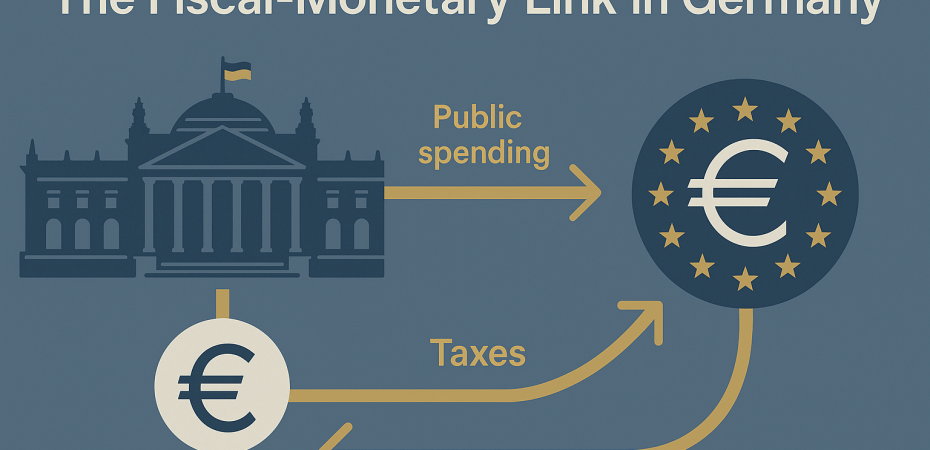
Studying the concrete functioning of public spending in Germany, within the eurozone, reveals a fundamental truth: even without control over monetary creation, the state « spends first. » This conclusion, drawn from the work of Dirk H. Ehnts, is based on a detailed analysis of the German institutions involved in the chain of public spending and debt management.
A complex but clear institutional apparatus
The German Ministry of Finance has an account at the Bundesbank, the national central bank. This central account (Zentralkonto) is managed by the Bundeskasse, itself an organ of the ministry. State spending is therefore technically carried out by the Bundesbank, which acts as an executor. However, the German government can only spend if it has a positive balance in this account, which requires it to collect taxes and issue debt securities.
Debt management is handled by the German financial agency (Deutsche Finanzagentur GmbH), which organizes securities issuances on a primary market reserved for a select group of banks. These banks refinance themselves with the ECB to purchase the securities, meaning that public spending is ultimately financed by central bank money creation.
The Taboo on Direct Monetary Financing
Article 123 of the Lisbon Treaty prohibits the ECB from directly financing Member States. However, since 2015, the ECB has been purchasing sovereign securities on the secondary market on a massive scale, as part of the PSPP. Mario Draghi’s announcement in 2012 that he would do « whatever it takes » to save the euro changed the perception of the ECB as a de facto lender of last resort.
But this indirect assistance does not eliminate the political constraints imposed on states: a ban on excessive deficits, the obligation to fund their accounts before spending, and dependence on financial markets. This architecture maintains a fiction: that of public financing through the market, while money always comes, ultimately, from the central bank.
Analytical Consolidation and Functional Reality
Ehnts defends the consolidation hypothesis: to understand the logic of the monetary circuit, it is relevant to analyze the Treasury and the central bank together. Interbank transactions mask the fact that public spending is injected into the economy via central money creation, while taxes and securities sales withdraw this money.
To illustrate the absurdity of the current institutional setup, Ehnts uses the image of a « shell game. » This metaphor reflects the complexity deliberately introduced into the monetary circuit, where banks borrow from the ECB to purchase securities issued by the government, which then deposits them with the central bank for spending. This detour, with no real functional utility, seems to serve the sole purpose of masking the central bank’s original role in public financing. It reflects an ideological staging of the market as a necessary condition for public spending, whereas it is the central bank that provides the essential reserves at each stage.
In short, the state does not simply « distribute » pre-existing wealth: it creates it through its spending. Taxes and securities do not precede spending; they follow it. The private sector cannot create reserves at the central bank; it must obtain them either through public spending or through borrowing from the ECB.
Restricted Monetary Autonomy
Germany remains in a hybrid situation: at once a major economic power, capable of attracting strong demand for its securities (even at negative rates), but bound by a European architecture that prohibits direct monetary financing. This paradox reveals the limits of fiscal autonomy in the eurozone. Yet the functional logic demonstrated by Ehnts holds true: the state spends first because it alone, through its central bank, can inject the reserves necessary for the economy to function. This remains true even within the institutional constraints of the European Treaty. Recognizing this fact should transform the way economic and fiscal policies are designed on the continent.
 MMT France